Bond-Dissociation Energy
Python API · stjames models · API example
How it works
The bond-dissociation energy (BDE) workflow estimates the strength of selected bonds under homolytic cleavage: each fragment retains one electron from the broken bond. It optimizes the neutral, closed-shell starting molecule and the two doublet radical fragments, then subtracts the parent energy from the sum of the fragment energies. The selected mode determines the geometry and energy methods. An empirical correction is applied automatically to estimate gas-phase bond-dissociation enthalpies.
Settings
- Bonds: use "Add Bond" to choose the two atoms of each bond in the viewer or enter their atom numbers. For multiple structures, these atom numbers apply to every structure, so check that they identify the intended bonds throughout.
- Bond groups: "All C–H bonds?" selects carbon–hydrogen bonds and is on by default. "All C–X bonds?" selects carbon–halogen bonds and is off by default. These selections can be combined with individual bonds.
- Mode: "Rapid NNP" is the default and is recommended for most work. The alternatives use the protocols below.
Modes
| Mode | Optimization | Energy evaluation |
|---|---|---|
| "Rapid NNP" | OMol25's eSEN Conserving Small | OMol25's eSEN Conserving Small |
| "Rapid semiempirical" | GFN2-xTB | g-xTB single point |
| "Careful DFT" | GFN2-xTB | r²SCAN-3c single point |
Notes
Each starting structure must be a connected, neutral singlet. Selected bonds must separate it into two radical fragments; bonds within rings are unsupported by the web form.
Inspect the fragment structures and warnings alongside the BDEs. A missing BDE indicates that fragment energies could not be obtained; further fragmentation during optimization can make a result unreliable. The workflow uses optimized electronic energies with fitted corrections, rather than calculating vibrational and thermal corrections for each molecule. BDEs describe bond-breaking thermochemistry and do not directly predict reaction rates.
Submission video
Benchmarks and validation
ExpBDE54 benchmark and corrections
ExpBDE54 contains experimental gas-phase bond-dissociation enthalpies for 54 small molecules, primarily C–H and C–halogen bonds. The published linear-fit parameters and root-mean-square errors (RMSEs) for the matching protocols are:
| Mode | Slope | Intercept (kcal/mol) | RMSE (kcal/mol) |
|---|---|---|---|
| Rapid NNP | 0.916 | 2.206 | 3.557 |
| Rapid semiempirical | 0.928 | −0.295 | 4.658 |
| Careful DFT | 0.945 | 3.303 | 4.014 |
The NNP row uses eSEN geometries; the other rows use GFN2-xTB geometries. These errors are evaluated on the same dataset used to fit the corrections, so they do not establish accuracy for other bond types or larger molecules.
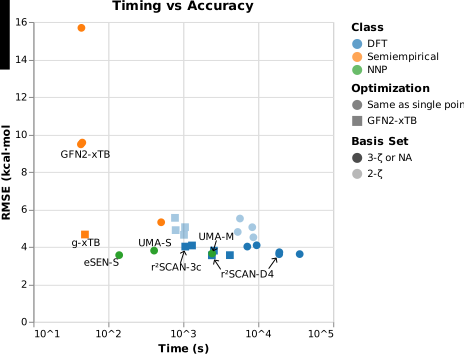
Figure 11 from our ExpBDE54 study: accuracy versus speed of BDE methods. g-xTB on GFN2-xTB geometries and eSEN-S offer favorable accuracy–speed tradeoffs. Times are totals for the dataset on four CPU cores.