Blood–Brain-Barrier Permeability
Python API · stjames models · API examples
How it works
Rowan estimates the probability that a molecule will be brain-penetrant using its ionization behavior and aqueous solvation energy. The approach follows work by Morgan Lawrenz and co-workers, with Starling, AIMNet2, and CPCM-X providing faster calculations. The result is a probability of belonging to a brain-penetrant class, rather than a numerical prediction of Kp,uu (the unbound brain-to-plasma concentration ratio).
Settings
BBB prediction is an option within macroscopic pKa prediction.
- BBB calculation: Enable "Compute solvation energy and BBB permeability?" It is off by default in the web form.
- Method: The web form uses "Starling (Uni-pKa architecture)."
- Charge range: "Min charge" and "Max charge" default to −2 and +2. Include the neutral charge state and all plausible ionization states; excluding relevant states can distort the result.
- pH range: "Min pH" and "Max pH" default to 0 and 14 for the accompanying property plots. The BBB calculation always evaluates ionization at pH 7.4.
- Solubility: "Predict pH-dependent aqueous solubility?" is on by default in the web form. This adds Kingfisher solubility predictions and is independent of the BBB calculation.
Notes
Starling estimates the populations of different protonation and tautomeric states. A state penalty measures how unfavorable it is to occupy neutral states at pH 7.4, favoring states with the fewest formal atomic charges over zwitterions when possible.
For a representative neutral state, Rowan generates conformers with RDKit's ETKDG method, optimizes them in the gas phase with AIMNet2, and applies GFN2-xTB/CPCM-X water corrections. It combines the conformer energies into an aqueous solvation score and subtracts the state penalty. A logistic-regression model converts this corrected score into the BBB probability.
The "BBB" tab shows the corrected solvation energy in kcal/mol and the predicted penetrance probability. Use these results to prioritize compounds for experimental evaluation. Predictions are less reliable when the enumerated states omit important chemistry or contain no net-neutral state.
Submission video
Benchmarks and validation
Accuracy
The published Starling workflow was evaluated on 123 experimental Kp,uu values reported by Lawrenz and co-workers at Schrödinger using five-fold stratified cross-validation. It achieved AUC = 0.85 and 75% accuracy at a probability decision threshold of 0.5, with more false positives than the DFT-based comparison model. These are classification results for the reported dataset. For details, read the full paper.
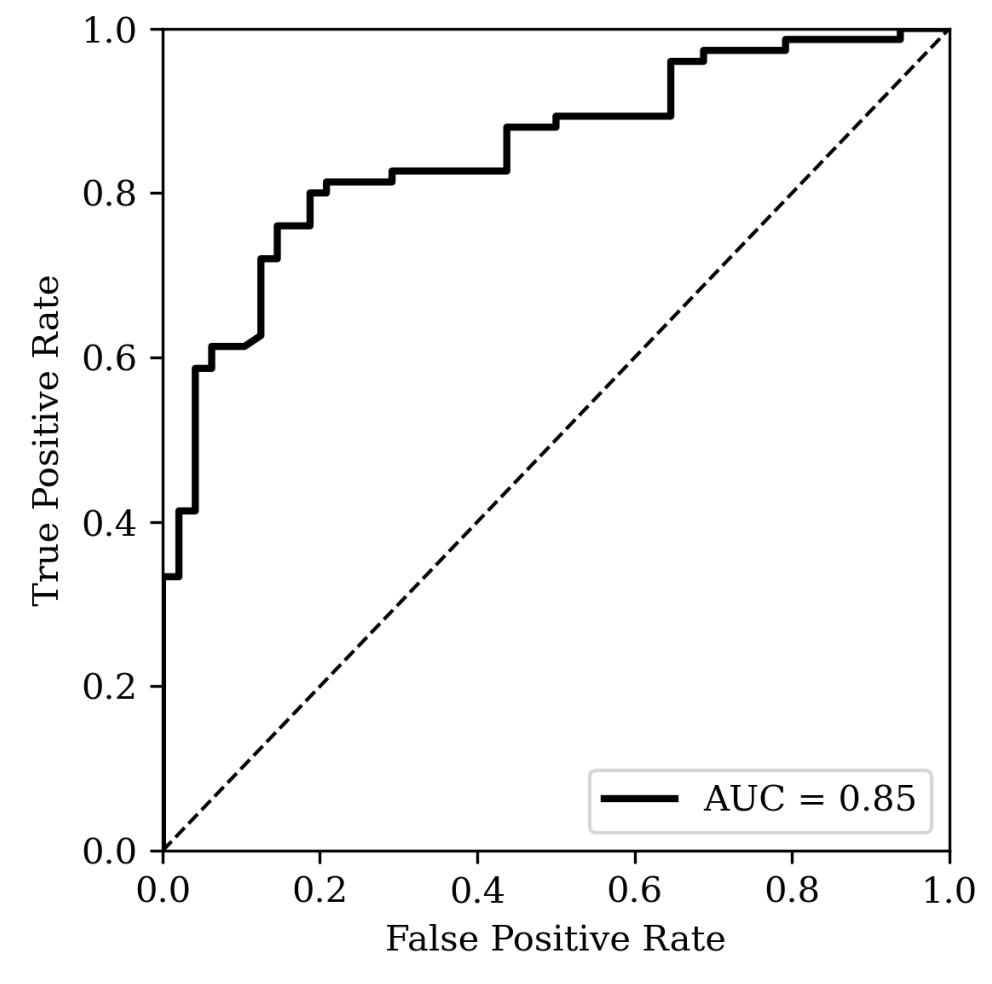
ROC analysis for classifying compounds above or below Kp,uu = 0.3, as reported in our Starling announcement. AUC = 0.85, without compound-specific fine-tuning.