Solubility Prediction
Python API · stjames models · API example · API example
How it works
Rowan predicts how much of a compound dissolves in a selected solvent. Use fastsolv to compare solvents and temperatures, or Kingfisher and ESOL for room-temperature aqueous solubility. Results are reported as logS: the base-10 logarithm of concentration in mol/L. For example, a logS of −3 corresponds to 1 mmol/L; a one-unit increase means ten times greater solubility.
Settings
- Method: choose fastsolv for organic solvents, Kingfisher for a neural-network aqueous prediction, or ESOL for a simpler descriptor-based aqueous estimate. fastsolv has reduced accuracy in water.
- Solvents: fastsolv accepts one or more solvents from the list or custom names/SMILES. Names are resolved through PubChem. Kingfisher and ESOL support water only.
- Temperature range: for fastsolv, "Start (°C)" and "Stop (°C)" define the endpoints; "Num" selects 1–30 evenly spaced temperatures. With "Num" set to 1, only the start temperature is used. API temperatures are in kelvin. Kingfisher and ESOL require 25 °C (298.15 K).
- Defaults: "Set default Kingfisher settings" or "Set default ESOL settings" selects water and 25 °C for the corresponding method.
Notes
fastsolv
fastsolv is an ensemble of neural networks trained on BigSolDB. It uses solute and solvent structures plus temperature to predict each selected combination. See the authors' paper and web interface.
The reported standard deviation measures disagreement among the models, in logS units; it is not a guaranteed experimental error bound. The interface accepts temperatures beyond the training data, so accepting a value does not establish prediction accuracy there.
Aqueous solubility
Kingfisher and Rowan's reparameterized ESOL were trained on the Falcón-Cano reliable aqueous-solubility dataset. The Rowan study interprets these data using an assumed pH of 7.4; this is not a guarantee that every measurement was made at that pH. These predictions describe aqueous solubility, rather than intrinsic solubility of the neutral compound alone. This workflow has no pH setting. Use the macroscopic pKa workflow for pH-dependent solubility estimates.
Kingfisher
Kingfisher fine-tunes the pretrained CheMeleon molecular graph model for aqueous solubility.
ESOL
ESOL uses a linear combination of molecular weight, calculated octanol–water logP, rotatable-bond count, and aromatic-atom proportion. Rowan refit its coefficients using the Kingfisher training dataset and an RDKit-based implementation.
Kingfisher and ESOL return a single prediction without an uncertainty estimate.
Benchmarks and validation
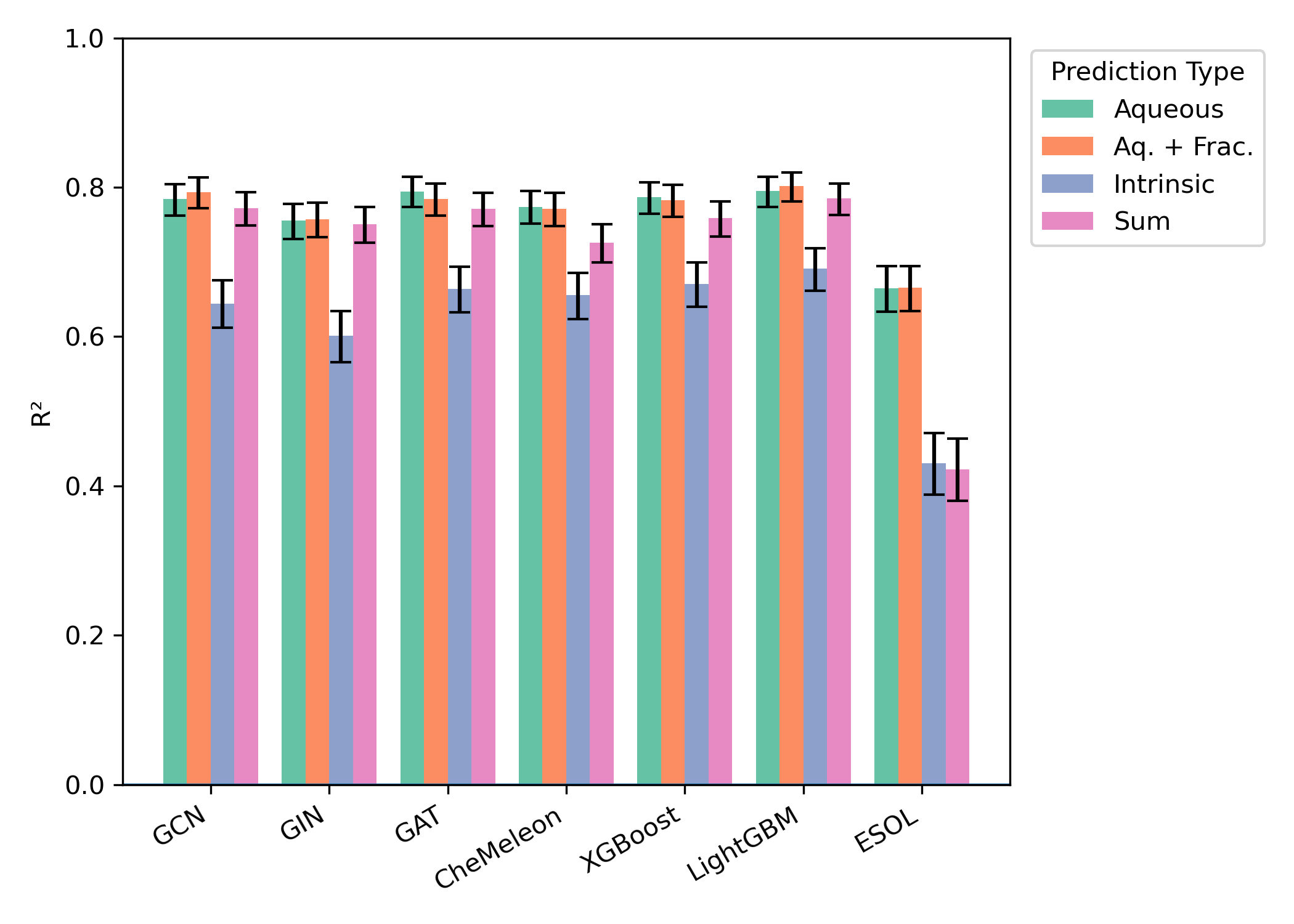
Model performance on a 1,255-molecule Butina-split test set. Figure from our aqueous-solubility paper.