Solvent-Dependent Conformer Search
Python API · stjames models · API example
How it works
A molecule's preferred conformations can change with solvent. This workflow builds a diverse conformer ensemble and compares its predicted populations, average molecular properties, and free energy across selected solvents. Use it to study changes in molecular shape or exposed polarity and to estimate transfer free energies and partition coefficients.
Settings
- Enumerate tautomers?: off by default. Includes alternative tautomers and zwitterionic forms with the same net charge, screening them before conformer generation.
- Solvents for analysis: choose at least one solvent. Defaults are hexane, octanol, chloroform, dimethyl sulfoxide (DMSO), and water.
- Conformer generator: openconf is the default; iMTD (CREST) is also available.
- Energy window (kcal/mol): controls the range of energies retained during conformer generation. Wider windows preserve more candidates but increase subsequent work.
- Final correction: CPCM-X is the default solvent treatment. COSMO-RS uses a more expensive DFT calculation for each conformer, then evaluates its solvation in every selected solvent.
- API optimization settings: customize the geometry optimization and final electronic-energy methods through the linked API. The default uses GFN2-xTB with ALPB water for optimization and g-xTB for electronic energies.
Notes
Solvent-aware clustering selects representatives using energy rankings in the chosen solvents. The retained conformers are optimized once, then scored in each solvent using their electronic energy, a GFN2-xTB thermal correction, and the selected solvation treatment. The workflow compares the same optimized geometries across solvents, with populations determined separately for each solvent.
Results include conformers, per-solvent free energies and relative energies, and Boltzmann populations at 298.15 K. Boltzmann-averaged solvent-accessible surface area, polar surface area, and radius of gyration describe the ensemble's average exposure and size. Changes in these averages reflect changes in conformer populations.
Each solvent's relative ensemble free energy is reported in kcal/mol, with the lowest-energy solvent set to zero. Subtract the source solvent's value from the destination solvent's value to obtain the predicted transfer free energy. This ensemble comparison includes contributions from all retained conformers.
COSMO-RS requires supported elements and solvents. Sampling and filtering can miss relevant conformers; tautomer enumeration preserves the input's net charge and does not model pH-dependent ionization.
Benchmarks and validation
We evaluated octanol/water LogP predictions for 15 flexible molecules with experimental values from ChEMBL, following Novartis's physics-based approach. In this benchmark, openconf-based ensembles ran twice as fast as the previous iMTD-GC settings.
LogP predictions from openconf agree closely with CREST (, MAE = 0.11). Compared with experimental LogP, openconf gives and MAE = 1.10.
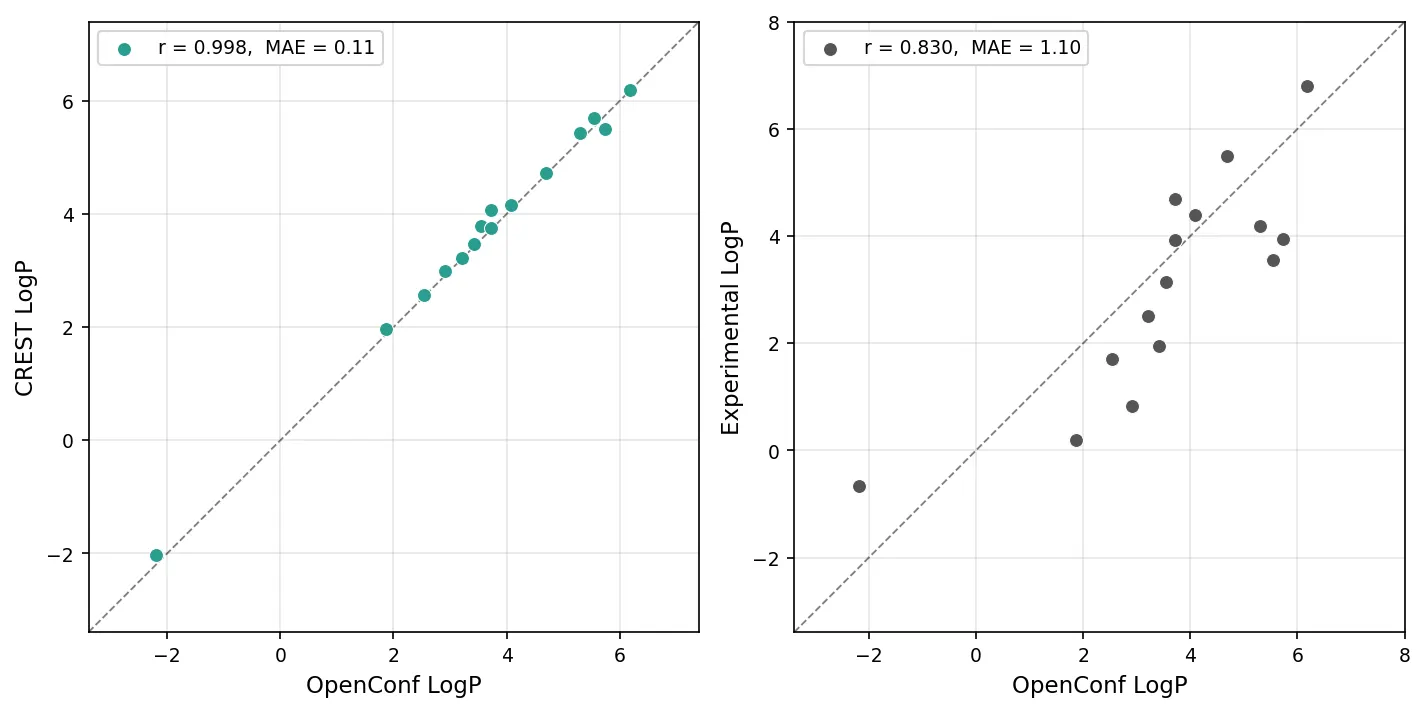
LogP from openconf compared with CREST (left) and experiment (right).