Double-Ended Transition State (TS) Search
Python API · stjames models · API example
How it works
Double-ended transition state (TS) search builds a reaction path between reactant and product geometries and uses its energy maximum to estimate a TS. The result includes structures and energies along the path, plus a TS guess or an optimized TS with vibrational frequencies.
Settings
- Inputs: supply reactant and product geometries with the same atoms, charge, spin multiplicity, and atom ordering. Each index must identify the same atom in both structures. Use the reindex tool if needed. For reactions involving several molecules, include all fragments together in each endpoint geometry.
- Level of theory: choose a method suitable for the reaction and both endpoints.
- Search method: choose "String method (FSM/GSM)" or "Nudged elastic band (CI-DNEB)." The web form defaults to the string method.
- Freeze new nodes?: for string searches, freezing newly optimized path structures gives the freezing string method (FSM; default). Turning freezing off gives the growing string method (GSM), which continues relaxing the path as it grows.
- Interpolation method: choose how intermediate geometries are placed: "Geodesic" (default), "Cartesian," "Linear synchronous transit," "Redundant internal coordinates," or "IDPP." Redundant internal coordinates are unavailable for periodic structures.
- Optimize inputs?: relax the endpoints before searching. Enabled by default in the web form. Consider disabling this if carefully arranged fragments would otherwise separate or move away from the intended reaction geometry.
- Optimize TS?: optimize the TS estimate and calculate vibrational frequencies. Enabled by default. With this off, the result remains a guess.
Notes
String methods grow a chain of structures from both endpoints until they connect. NEB relaxes a band of intermediate structures, with a climbing image targeting the energy maximum. Learn more in our Guessing transition states blog.
Inspect the path for the intended bond changes. A wrong correspondence between atoms of the same element can pass input checks and still produce an incorrect pathway. Searches can fail or follow an unintended mechanism, particularly for reactions with several steps.
For an optimized TS, check for one significant imaginary vibrational frequency and confirm that its motion matches the intended reaction. An intrinsic reaction coordinate (IRC) calculation can check which reactant and product minima it connects; this workflow does not run IRC automatically.
Benchmarks and validation
Our benchmark used the 25 small-molecule transition states from the Baker TS set, originally generated with HF/3-21G. We re-optimized them with UMA-S-1.2-OMol and generated reactant and product endpoints with IRC calculations.
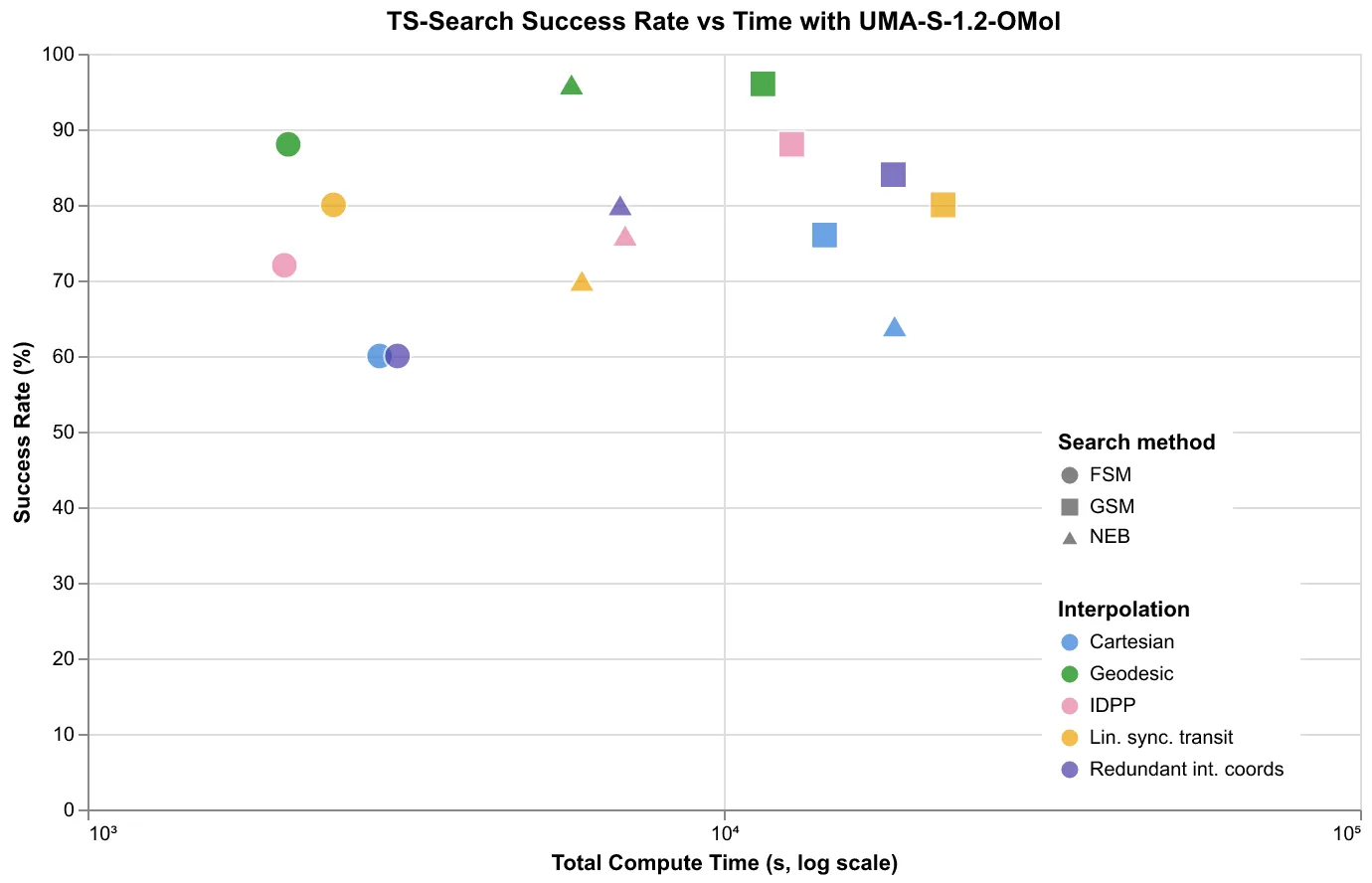
Total compute time for double-ended TS search followed by TS optimization on the Baker25 set, using UMA-S-1.2-OMol on an A100 GPU.
In this benchmark, geodesic interpolation gave the highest success rate for each search method. FSM was substantially faster than GSM or NEB, with a modest reduction in success rate.