NMR Prediction
Python API · stjames models · API example
How it works
Rowan predicts 1H and 13C NMR chemical shifts to help compare candidate structures with an experimental spectrum. MagNET-Zero, a neural network trained on DFT calculations, predicts shieldings from 3D geometries. Rowan adds a learned solvent correction and converts shieldings to chemical shifts in ppm.
With a conformer search, the workflow averages shifts across the ensemble using Boltzmann populations at 298.15 K. Equivalent nuclei are grouped into peaks, including averaging over rapidly rotating methyl hydrogens. Results include atom assignments, per-conformer shifts, and supported proton–proton coupling constants in Hz.
Settings
- Solvent: choose the solvent used for your experimental spectrum. Chloroform is the default. Also supported are tetrahydrofuran, dichloromethane, acetone, acetonitrile, dimethyl sulfoxide, methanol, water, benzene, toluene, and chlorobenzene. The selection affects the shielding correction and conformer energies.
- Run conformer search?: off by default. Enable it for flexible molecules whose spectra may reflect several conformations. Rowan generates conformers with openconf, optimizes them, and averages the significant conformers' predictions. Without a search, the workflow evaluates the supplied geometry after any selected optimization.
- Optimize structure(s)?: on by default. AIMNet2 optimizes the geometry before shift prediction. Optimization is required when a conformer search is enabled. Disable it only when you already have suitable AIMNet2-optimized coordinates; other geometries may give less accurate shifts.
Notes
The model supports molecules containing only H, C, N, O, F, S, and Cl, and predicts shifts only for H and C. Chemical shifts depend on stereochemistry, conformation, and protonation state: compare the structure present under your experimental conditions. Solvent selection does not enumerate protonation states or model explicit solvent molecules.
Proton–proton couplings use empirical relationships, including the generalized Karplus equation for saturated vicinal couplings. Exchangeable-proton and unsupported long-range couplings are omitted. Treat the displayed splitting as an approximate aid to assignment.
Benchmarks and validation
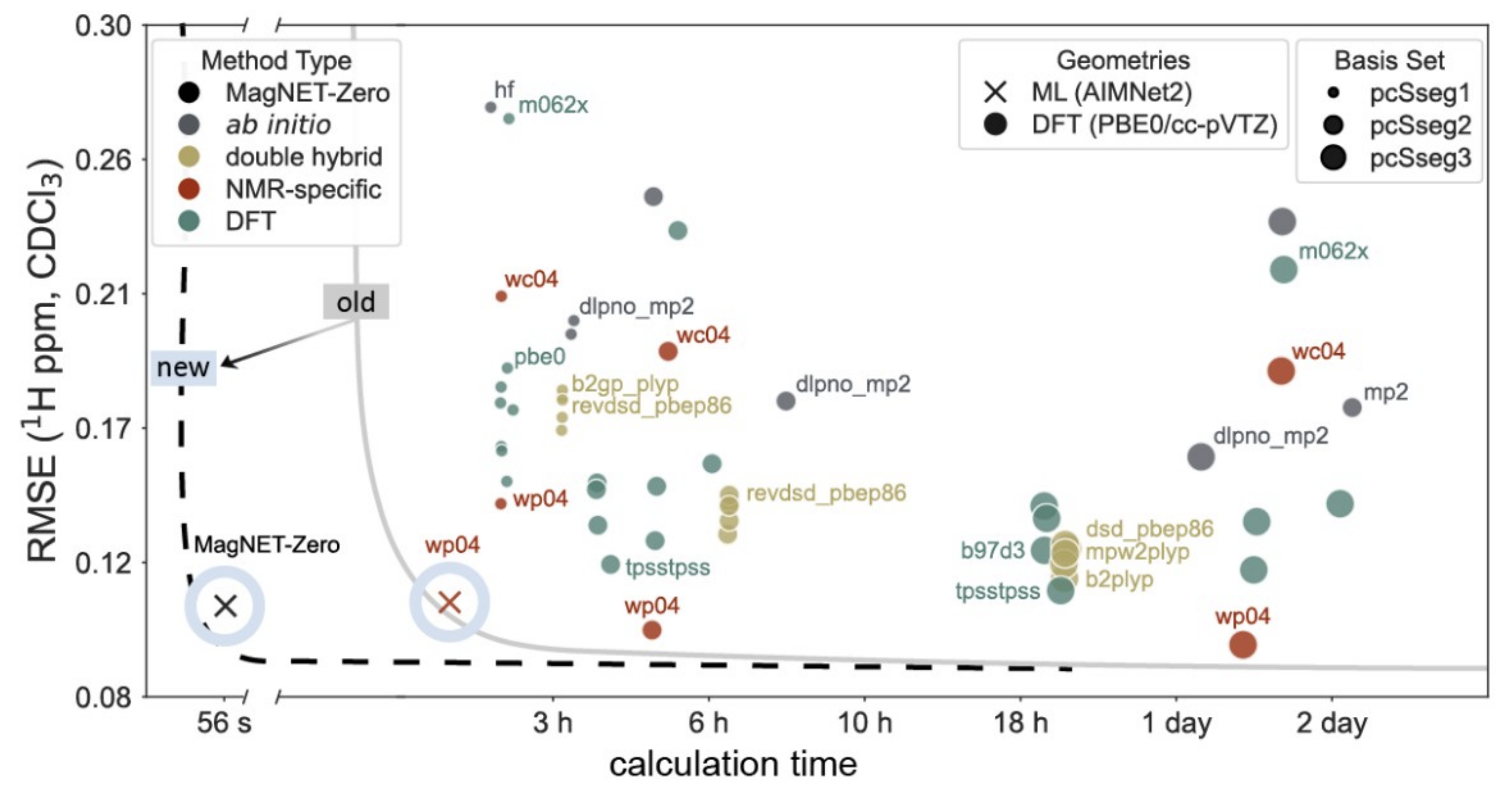
The existing accuracy plateau: 1H chemical-shift RMSE in CDCl3 versus calculation time. Figure from Chemical shift prediction beyond the electronic structure limit.
In Rowan's eight-molecule structure-elucidation case study, predicted 13C shifts for the correct structures had a mean absolute error of 1.20 ppm and an RMSD of 1.60 ppm against experiment. These selected, challenging cases are a small validation set; the errors are not a general accuracy guarantee.