Ion-Mobility Mass Spectrometry Prediction
Python API · stjames models · API example
How it works
Predict the collision cross section (CCS) of a molecular ion in nitrogen gas. CCS, reported in Å2, describes how strongly the ion collides with the gas and depends on its shape, charge, and conformation. Compare predictions with measurements for the same ion or adduct and bath gas to help assess candidate structures.
Settings
Use connected, non-periodic structures with elements supported by the workflow.
- Protonate? Off by default. Add one proton at possible nitrogen, oxygen, or sulfur sites, then use the protonation variant whose lowest-energy conformer is most favorable. This option always runs conformer search. Leave it off to calculate the charge state or adduct you supplied.
- Temperature (K) Nitrogen bath-gas temperature for CCS calculations; defaults to 300 K. Conformer populations are always weighted at 298.15 K, independently of this setting.
- Run conformer search? On by default. Generate and optimize multiple conformers to account for molecular flexibility. When off, use only the supplied geometry, with optional optimization.
- Optimize structure(s)? On by default. Relax the geometry before calculating CCS. The form keeps this enabled when conformer search is on.
Notes
Conformer search uses openconf, GFN2-xTB geometry optimization, and g-xTB energy ranking. Rowan's modified CoSIMS simulates ion–nitrogen collisions using AIMNet2 partial charges. CCS calculations focus on conformers with predicted populations above 0.1%.
The main result is a Boltzmann-weighted mean CCS. Individual conformer CCS values and weights help show whether different shapes give similar predictions or whether the result depends strongly on the conformer ensemble. The reported standard deviation combines the variation among conformers with each collision calculation's statistical uncertainty; it does not quantify all possible error relative to experiment. Conformers whose collision calculations fail are omitted and the remaining weights are renormalized.
Automatic protonation searches possible sites rather than predicting pKa or combining populations of different protonation variants. If no usable variant is found, supply the intended protonated structure manually. The choice of ion and the completeness of the conformer ensemble remain important when interpreting agreement with experiment.
Benchmarks and validation
In our published benchmark, CCS predictions for 190 [M+H]+ biomolecules from Zheng and co-workers' 2017 dataset had a mean absolute percentage error of 5.65% and , with some systematic bias.
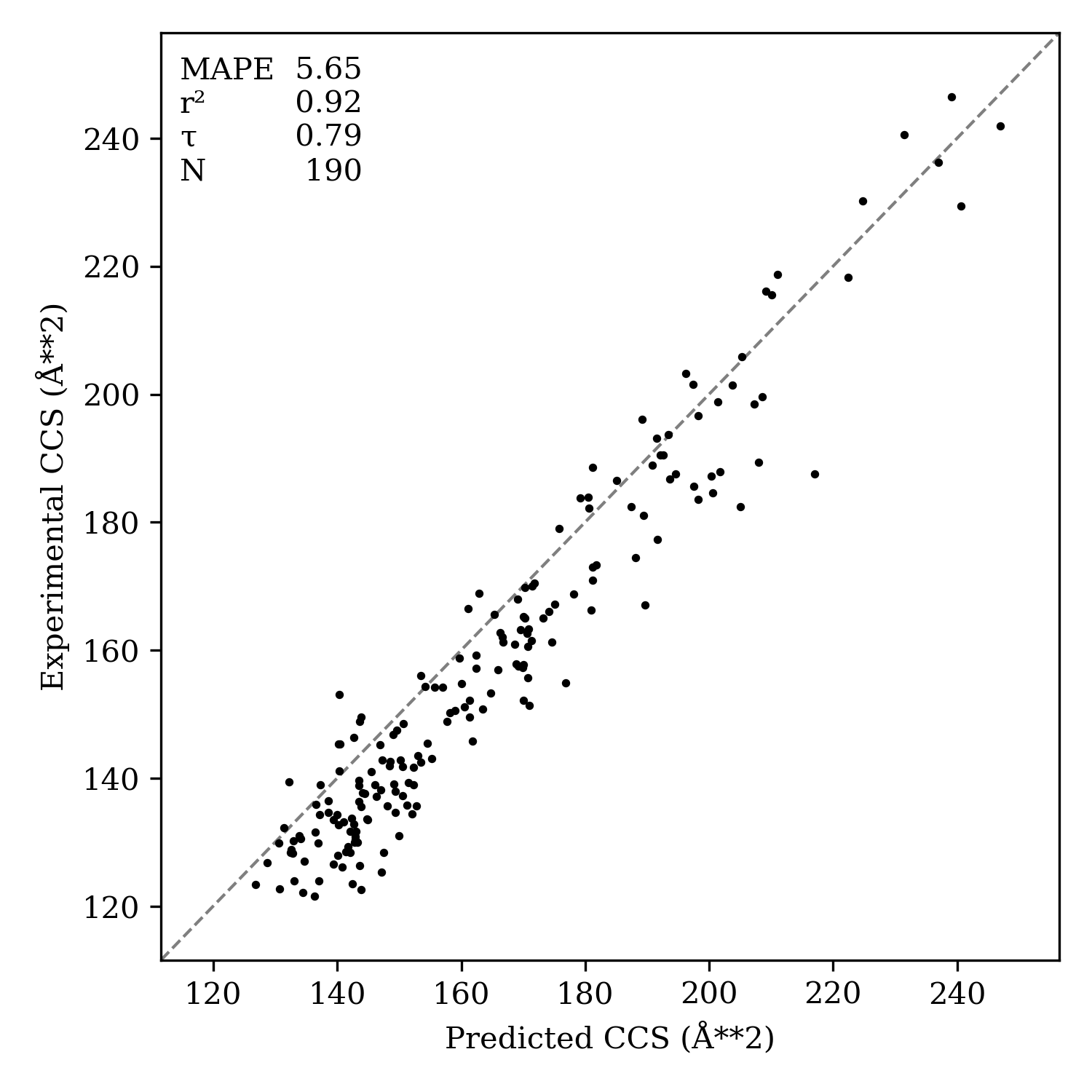
Predicted versus experimental CCS. This benchmark used CREST conformer search and a 1% population cutoff.