Time-Dependent Density-Functional Theory (TDDFT)
Time-dependent density-functional theory is an extension of DFT to excited states. Runge and Gross showed in 1984 that similar to traditional ground-state DFT, the time-dependent electron density also uniquely determines the properties of the system, and thus showed that excited states could be modeled without needing to use the wavefunction. This provides an alternative to expensive ab initio methods like configuration interaction, equation-of-motion coupled-cluster theory, or active-space methods.
The functional for excited states needs to be more complicated than for ground states (see The Charlotte’s Web of DFT for more on functional forms), as it depends on both the 3D density and the time evolution (i.e. it is non-local in time). Real-time TDDFT (RT-TDDFT) performs this propagation directly in time and is useful for non-linear responses (e.g. high-intensity fields) or ultrafast processes (where there is not enough time for the density to stabilize). Linear-response TDDFT (LR-TDDFT) is more common and significantly faster, and is thus usually just referred to as TDDFT. It is formalized as an expansion in electron–hole pairs and is usually cast in the Casida equation (shown below for pure DFT, hybrid TDDFT adds additional integrals to A and B):
Equation 1: Casida equation for pure TDDFT and its constituents.
- A governs the excitations between occupied (i, j) and unoccupied (a, b) orbitals
- B couples the excitations and de-excitations
- X is the excitation amplitude vector (particle–hole coefficients)
- Y is the de-excitation amplitude vector (hole–particle coefficients)
The Tamm–Dancoff approximation (TDA-TDDFT) simplifies the Casida equation (equation 1) by decoupling excitations and de-excitations (e.g. resonance) by setting the B coupling matrix to 0. This makes the matrix block diagonal; each block can have its eigenvalues solved independently (for real transitions the eigenvalues of both blocks are identical since the eigenvalues of A are conjugate to those of A*), leading to:
Equation 2: TDA-TDDFT equation, derived by setting B = 0 in equation 1, and solving the X block
Excitation energies computed with TDA-TDDFT are often very close to their full TDDFT values, and it avoids triplet instabilities and unphysical negative eigenvalues that can arise in the full LR-TDDFT. There are downsides, however: oscillator strengths are typically underestimated and the TDA approximation can fail for highly correlated systems or systems with near degeneracies.
Further simplifications can be made, with the most popular being simplified TDA-TDDFT (termed sTDA-TDDFT or sTDA for short). sTDA approximates the Coulomb and exchange correlation integrals, and , in A as damped interactions between transition-density monopoles (derived from the Löwdin charges). The active space is truncated for single-excitations with large orbital energy differences (e.g. >15 eV), with a subset of strongly coupled configurations included (typically identified via perturbative screening). sTDA is particularly popular when used with semiempirical methods, enabling the calculation of excitations for systems with thousands of atoms.
The functional form of TDDFT is also important. Pure (non-hybrid) functionals often predict HOMO–LUMO gaps that are too small, leading to spurious low-lying charge-transfer states (though their poor absorption means they often have minimal effect on the resultant UV-Vis spectrum). Hybrid functionals show better excitation energies, but give poor results for charge-transfer excitations. Range-separated hybrids are typically preferred due to the correct long-range behavior, and the accuracy can be further improved by tuning of the range-separation parameter (ω) such that the ionization potential matches the HOMO orbital energy (commonly referred to as Koopmans’ tuning). Double hybrids offer a further increase in accuracy, but add considerable cost due to the O(N5) scaling perturbative correction (though this can be mitigated somewhat by only using the opposite spin (OS) component of the MP2 correlation).
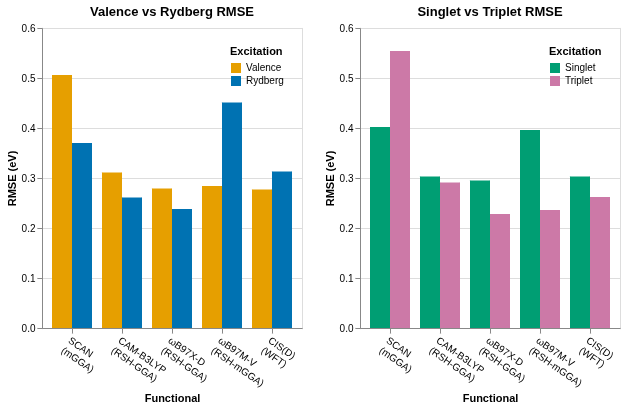
Functionals evaluated on QUESTDB excitation energies, data from figure 6 of Liang et al.
Things to note:
- TDDFT is only valid for single excitations (double excitations cannot be described)
- Charge-transfer excitations require properly tuned range-separated hybrids
- Rydberg states and excitations with diffuse character often require larger basis sets
- Conical intersections and non-adiabatic dynamics require RT-TDDFT
- Core excitations require a restricted excitation window
Recommendations
Functional
In general, it is best to use a range-separated hybrid (RSH) functional like CAM-B3LYP or ωB97M. The accuracy can further be improved by properly tuning ω, though this can be prohibitively expensive for a large screen. Some practitioners just tune on a representative molecule, or set ω to half the default value.
If performing large-scale screening of UV-Vis spectra and only approximate values are needed or convergence issues are encountered, GGAs like r2SCAN can provide a ≈2x speedup over RSH functionals, but they are not recommended for excited-state optimizations.
Basis set
Due to the cancelation of errors between the ground and excited state energies, small basis sets can often provide reasonable results. There is debate in the literature as to the benefit of augmented functions; augmentation slows down calculations substantially, but can provide significant benefit to the calculation of Rydberg states. The def2-SVP basis set is often accurate enough for large-scale UV-Vis screenings, while def2-TZVP(-f) is recommended for more routine work. def2-TZVPD is recommended for Rydberg states or when greater accuracy is needed.
Number of roots
When calculating UV-Vis spectra of small molecules (<30 atoms), 10 roots are often sufficient for the visible portion of the spectrum. For medium-sized molecules (<50 atoms) or simulating the UV region, 20–50 roots are recommended.
Overall recommendations
There are many considerations when running TDDFT, but in general, we recommend the following settings when starting out:
- UV-Vis screening: ωB97X-D3BJ/def2-SVP
- Routine: ωB97X-D3BJ/def2-TZVP(-f)
- Rydberg: ωB97X-D3BJ/def2-TZVPD
The web of density-functional theory can be confusing to most practitioners. There has been a proliferation of many functional forms and parameterizations, each with its benefits and drawbacks. The Rowan platform provides access to all of the above functionals: start running them today with free credits, and contact us if you have any questions.
Further reading: